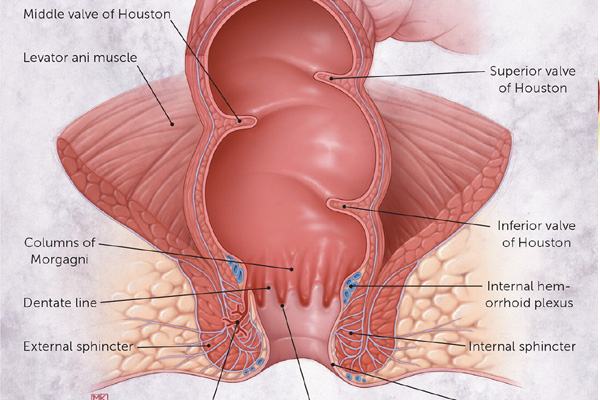
Hemorrhoids are a collection of blood in the venous system (engorged veins) that occurs in the anal/rectal region either internally or externally. They are one of the most common anorectal conditions in general surgery and also in the general population. Most of the lowgrade hemorrhoids (grade I and II) are managed conservatively, while the high-grade hemorrhoids (grade III and IV) often require a surgical approach.
1. Risk Factors and Treatment Options for Hemorrhoids
There are so many risk factors to the development of hemorrhoids such as chronic constipation, anal intercourse especially for men who have sex with men, and obesity.
There are many treatment approaches when dealing with hemorrhoids such as hemorrhoidectomy, hemorrhoid stapling, and hemorrhoid banding. Each has unique advantages over the other approaches.
Hemorrhoid stapling is the approach used for advanced prolapsed rectal hemorrhoids that need to be returned into the rectal/anal cavity while limiting their blood supply so that they can strangulate and shrivel off. The main advantages of hemorrhoid stapling are decreased postoperative pain, shorter hospital stays, and fewer complications compared to the other hemorrhoid treatment modalities. The disadvantage of this approach is that the recurrences are high thus reoperation is much more common than other hemorrhoid treatment options. The underlying principle for this form of treatment is the strangulation of the blood supply of the hemorrhoids as they are highly vascularized structures, therefore, cutting them off the rectal mucosa in the process of selective ischemia.
2. Indications
Stapled hemorrhoidectomy is done for the internal hemorrhoids especially of the third grade to fourth grade.
3. How is this procedure done
The surgical procedure is quite straight forward am aims to cut off the blood supply of the hemorrhoids while pulling the hemorrhoids up the anal/rectal canal.The day before the surgery, the patient is given an enema to clear the contents of the rectum before the procedure is done. Prophylactic antibiotics are also indicated earlier. The patient is placed in the lithotomy position for easy accessibility of the rectum, then an anal dilator is used for the easier expansion for visualization of the rectum. A suture is tired about 5 cm above the dentate line of the rectum, above the internal hemorrhoids, and a stapler is introduced anally and stapled onto the rectal mucosa and the suture is pulled. This cuts off the blood supply of the affected hemorrhoids, therefore, will become ischaemic and die off with time in addition to pulling them back into the anal/rectal cavity.
4. Risks
Despite the great benefits of the stapled hemorrhoidectomy, it also has various drawbacks such as the recurrent prolapse of the hemorrhoids thus the patient has to be constantly reoperated to cure the condition. In addition to this, a high risk of sepsis has been reported in patients who have undergone this procedure than other hemorrhoid treatment approaches and it is, therefore, prudent to ensure that prophylactic antibiotics are given before the procedure. Other minor reported risks include thrombosis due to stasis of the blood in the anal mucosa after stapling and anal stenosis that could be as a result of how the procedure is normally carried out.
5. Patient preparation for the procedure
The patients normally leave for home at an average of about one day postoperatively. Going back home the same day is also feasible. The patient should be doing well a week after the surgery. The patient should be advised on the diet that is not hard on the healing post-hemorrhoid scar. A high fiber diet is recommended as well as plenty of water each day. Laxatives are a good aid for the bowel movement and especially to alleviate any constipation that might occur. Take the analgesic agents given after the procedure to reduce the pain. Avoid heavy lifting or any other strenuous exercise until the patient is fully healed, sitz baths are recommended at least once daily because they keep the area clean. The patient is required to show up for a follow-up examination in about 4 weeks post-surgery.
6. Recovery after surgery
The patients normally leave for home at an average of about one day postoperatively. Going back home the same day is also feasible. The patient should be doing well a week after the surgery. The patient should be advised on the diet that is not hard on the healing post-hemorrhoid scar. A high fiber diet is recommended as well as plenty of water each day. Laxatives are a good aid for the bowel movement and especially to alleviate any constipation that might occur. Antibiotics should be taken to prevent any infection. The use of prophylactic thrombolytic agents could be considered to prevent the formation of clots. Take the analgesic agents given after the procedure to reduce the pain. Avoid heavy lifting or any other strenuous exercise until the patient is fully healed, sitz baths are recommended at least once daily because they keep the area clean. The patient is required to show up for a follow-up examination in about 4 weeks post-surgery.
7. Outcomes
Patients prefer this treatment approach because of the lesser time spent during the procedure (only about half an hour) and the quick recovery and resumption to normal routines of the patients. Furthermore, the procedure is less painful compared to the rest of the hemorrhoid treatment approaches.